-1.png?w=520&h=124)
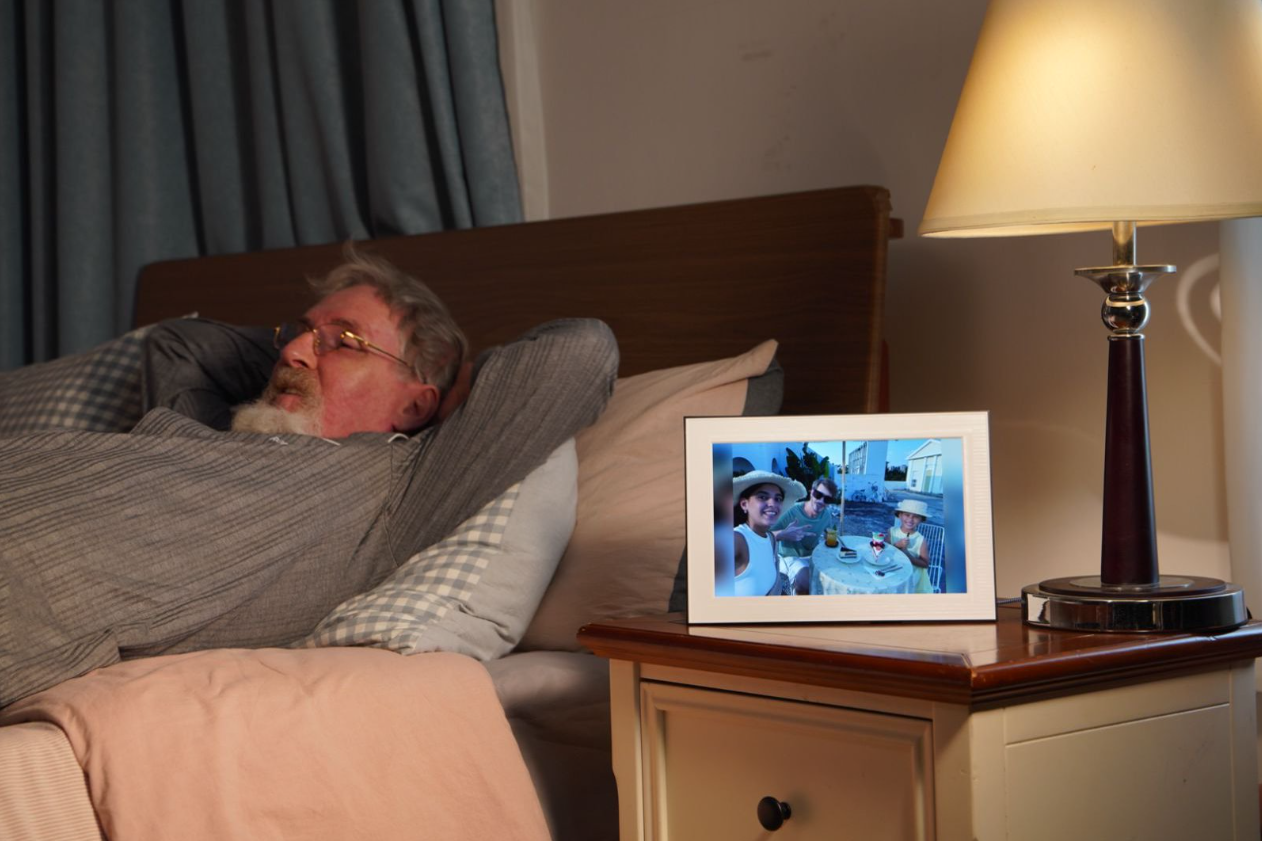
This story is told in two voices. Dorothy is 88 years old and has lived her entire life in Boulder, Colorado. Amy is her granddaughter, a junior at UC Berkeley. They sat together over Thanksgiving 2025 and told us how a small digital frame became the most important object in Dorothy's kitchen.
In This Story
"Don't Give Me One of Those Things"
DorothyI'm eighty-eight years old. I've lived my whole life right here in Boulder, Colorado — never left. Born here, married here, raised my children here, buried my husband here. This house, this kitchen, this view of the mountains through my window — it's all I've ever known, and it's all I've ever needed.
I never learned to read much. I can write my own name — Dorothy Mae Henderson — and I can read a few words here and there. Enough to get by at the grocery store. But I can't read books or newspapers. Never could. Growing up, my family needed me on the farm, not in a classroom.
I tell you this so you understand: when people talk about technology, they might as well be speaking a foreign language. I don't understand it. I don't trust it. And for a long time, I didn't want anything to do with it.
The Problem Amy Wanted to Solve
AmyEvery Thanksgiving, when the whole family gathers at Grandma's house, I'd spend hours trying to teach her how to use a smartphone. I set up a simple phone for her — big icons, big text, just the basics. Calls. Photos. FaceTime.
She'd learn it while I was there. She'd even get excited. "Oh, I see! I tap this green one!" And for a few days, it worked. But within a week of me leaving, she'd forget everything. The icons were too small for her to see clearly. She couldn't remember what each one did. The phone would update overnight and move things around, and she'd be completely lost again.
The breaking point was the video call incident.
DorothyAmy called me on that video thing. I could see her face on the little screen. I was so happy — she looked so pretty. I started talking to her. Telling her about the neighbor's new fence, about the pie I made. I talked and talked.
But she wasn't responding. She wasn't nodding, wasn't saying anything. I thought, maybe the connection is bad. So I talked louder.
Thirty minutes. I talked for thirty minutes before my daughter walked in and told me the call had been muted. I had pressed something on the screen by accident. Amy couldn't hear a word I said.
I was so anxious I broke into a sweat. I felt foolish. Like a silly old woman who can't figure out a simple phone.
After that, whenever Amy called, I felt a little afraid to answer. Not afraid of Amy — afraid of the phone. Afraid I'd do something wrong again and not even know it.
"I wasn't afraid of Amy. I was afraid of the phone. Afraid I'd do something wrong again and not even know it."
That broke my heart. My grandma — the strongest woman I know, the woman who raised five kids on a farm, who can gut a chicken and fix a fence post and make biscuits from memory — was afraid of a phone. Not because she wasn't smart enough. Because we kept giving her tools that weren't designed for her.
I knew I needed to find something different. Something that required absolutely zero interaction from her end. No tapping. No swiping. No icons to remember. Something that just worked.
"Just One Step: Plug It In"
AmyI did a lot of research. I looked at Skylight, Aura, and a few other digital photo frames. Most of them were close, but they still required some interaction on the receiving end — accepting photos, swiping through menus, connecting to WiFi through an on-screen keyboard.
Then I found the Homture Magic Frame.
What caught my attention was the gifting workflow. I could set up the frame entirely from my phone before giving it to Grandma. I could connect it to her WiFi, load the photos, configure the slideshow, enable the AI features — everything. All she had to do was plug it into the wall.
So last Thanksgiving, I drove up to Boulder with the frame already set up. I'd loaded it with about 300 family photos — some recent, some from the old family albums I'd scanned. I'd used the AI photo colorization to restore a few of Grandma's black-and-white photos. And I'd used AI Magic to turn one special photo into a short video.
I wrapped it up and gave it to her after dinner.
Dorothy: "Don't give me one of those things. I won't know how to use it."
Amy: "Just try it, Grandma. Just one step: plug it in. That's all."
Dorothy: "That's all?"
Amy: "That's all. I already did everything else."
We plugged it in together that evening. The frame powered on. The screen lit up. And Grandma's photos — her children, her grandchildren, her garden, her kitchen, holidays and birthdays spanning decades — started playing in a slow, gentle slideshow.
She watched it for twenty minutes without saying a word. Then she said, "Can it stay on all night?"
I set up the sleep schedule — on at 6 AM, off at 10 PM — and placed the frame on her kitchen counter, right next to the coffee maker, where she'd see it every morning.
The First Morning
DorothyThe first morning, I woke up early like I always do. Five-thirty. I went to the kitchen to make my coffee and start breakfast.
The screen lit up.
And there I was. Young.
Wearing a striped sweater I remember buying at the general store downtown. My hair was dark, not white. My face was smooth. I was standing in front of the old oak tree in our backyard — the one that fell in the storm of '94.
The photo was in color. Full, beautiful color. But I know for a fact that the original was black and white. We didn't have color film back then. Someone — Amy, I suppose — had made it color.
And then the young me moved. She blinked. She smiled. And she waved at me.
The young me waved at the old me.
I just stood there. My coffee was overflowing. I didn't notice. I stood there and looked at that girl in the striped sweater, and I thought — that's me. I haven't seen my young self in so long. I'd almost forgotten what she looked like.
You know what my first thought was? It wasn't "This is amazing." It was: "That's me. I was her once."
"The young me waved at the old me. I just stood there. My coffee was overflowing. I didn't notice."
"Is That Magic?"
DorothyI didn't understand how it worked. I still don't, if I'm honest. I know Amy did something with the computer, and now my old photos move and have color. But the "how" doesn't really matter to me.
When Amy came to visit the next time, I took her hand. I said:
Dorothy: "Amy, Grandma saw it. I saw that video. How — how did that happen? Is that magic?"
Amy: "It's real, Grandma. It's magic, and it's technology. But for you, it's the same thing. It's just something to make you happy."
Dorothy: "It does make me happy. Every morning, I see someone I know."
That conversation is when I understood what this frame actually meant to her. It wasn't about technology. It wasn't about photos. It was about recognition.
Grandma lives alone. She's 88. Her world is getting smaller every year — fewer visitors, fewer outings, fewer people who remember the things she remembers. That frame is a window into a world where she's still young, where the oak tree is still standing, where her children are small and her husband is alive.
She doesn't need to understand AI. She doesn't need to know what "photo colorization" means. She just needs to see her young self waving at her in the morning and know that someone loved her enough to make that happen.
When the Whole Family Joined
AmyAfter that first visit, I invited my mom, my uncle, and my two cousins to the frame through the Homture app. The multi-user feature lets multiple phones connect to the same frame, so anyone in the family can upload photos from anywhere.
At first, people were casual about it. My mom uploaded a few photos from a weekend trip. My uncle sent an old photo of him and Grandma from the '70s.
But then something shifted. It became a family project.
My cousin in Denver started scanning old family albums — photos none of us had seen in years. My uncle found a box of slides in his attic and had them digitized. My mom went through her old Facebook posts and pulled out every photo that included Grandma.
Every week, new photos appear on Grandma's frame. She doesn't know who sends them. She doesn't need to know. They just appear, like gifts slipped under the door.
DorothyLast week, a photo showed up that I hadn't seen in — oh, it must be fifty years. It was me and my husband at a church picnic. He was wearing his good hat. The one with the brown band. I'd forgotten about that hat completely.
And there it was, on my little screen, in full color. Like it happened yesterday.
I sat with my coffee and looked at it until the next photo came. I wasn't sad. I was grateful. Grateful that someone, somewhere in this family, found that photo and thought of me.
The Magic Window
DorothyI call it my Magic Window. Because that's what it is — a window. A window into the past, and a window to my family.
Every morning, I wake up, make my coffee, and stand in the kitchen watching it. The frame turns on by itself — I don't press anything. Sometimes it shows the grandchildren. Sometimes it shows the garden. Sometimes it shows someone I haven't thought about in years, and I stop and say their name out loud, just to hear it again.
When someone walks close to it, it does something special. It plays one of those moving pictures — the videos Amy made from my old photos. The young me waving. My husband tipping his hat. My daughter as a baby, reaching up with both hands.
The first time it happened with a visitor, my neighbor Peggy nearly dropped her tea. "Dorothy, your picture just moved!" she said.
I said, "I know. My granddaughter gave me magic."
Now I show it to everyone who comes over. The mailman has seen it. The pastor has seen it. My doctor's wife has seen it. I take their hand and walk them to the kitchen and I say, "Look. My granddaughter gave this to me. Look, that's the big tree in our backyard when I was young — do you remember it?"
Most of them don't remember the tree. But they remember me. And seeing me young on that screen, waving — it makes them smile. It makes us all smile.
"Look. My granddaughter gave this to me. Look, that's the big tree in our backyard when I was young — do you remember it?"
Amy's Perspective: Why This Frame Worked
AmyI've thought a lot about why the Homture Magic Frame worked for Grandma when nothing else did. Here's what I've come to understand:
1. Zero Interaction Required
Grandma doesn't touch the frame. Ever. She doesn't need to. It turns on by itself in the morning, plays photos all day, and turns off at night. The proximity sensor triggers AI videos when she walks by. There are no buttons to press, no menus to navigate, no accounts to log into. For someone who can't read and can't use a smartphone, this is everything.
2. The Gift Mode Changed Everything
Being able to set up the frame completely from my phone — WiFi, photos, settings — before giving it to Grandma was the key. I did the hard part. She did the only part she needed to do: plug it in. If this frame had required any setup on her end — even connecting to WiFi through a touchscreen — it would have failed.
3. The AI Made Old Photos Feel Alive
Grandma's most meaningful photos are from the 1950s and '60s — black-and-white prints that have been sitting in shoeboxes for decades. The AI colorization brought them into the present. When Grandma sees her young self in full color, it's not a historical artifact anymore — it's a person she recognizes. And the AI Magic video feature, where the person in the photo waves or smiles, took it one step further. It turned a memory into a moment.
4. The Family Stays Connected Without Pressure
The multi-user feature means the whole family can send photos to Grandma's frame without asking her to do anything. No calls she's afraid to answer. No apps she can't figure out. Just photos that appear like little gifts throughout the week. For Grandma, it's like receiving letters she doesn't have to open — they open themselves.
5. It Gave Her Something to Share
This is the part that surprised me most. Grandma doesn't just watch the frame — she shows it. To every visitor. To the mailman. To anyone who walks through her door. She's proud of it. She calls it "my Magic Window," and she takes people by the hand to see it.
For an 88-year-old woman who has felt increasingly left behind by technology, having one piece of tech that she not only understands but is proud to demonstrate — that's not a small thing. That's dignity.
"It's magic, and it's technology. But for Grandma, it's the same thing. It's just something to make her happy."
If You're Buying for a Grandparent
Here's my checklist — what I wish someone had told me before I started looking:
- Set it up before you give it. Use the Homture app's Gift Mode. Connect the WiFi at their house during a visit, pre-load photos, configure the sleep schedule. Their only step should be: plug in the cord.
- Scan the old photos. The photos that matter most to elderly family members aren't on anyone's phone — they're in shoeboxes and albums. Take an afternoon to scan them. Use AI colorization on the black-and-white ones. That's where the real magic happens.
- Use AI Magic on a photo of them. Not a landscape. Not a group shot. A photo of them, young. Seeing yourself wave back at you across 60 years — that's the moment. That's what Grandma still talks about.
- Invite the whole family. The more people uploading, the more surprises Grandma gets. It turns the frame into a living connection, not just a slideshow.
- Place it where they already spend time. Grandma's frame sits on the kitchen counter next to the coffee maker. She sees it every morning without going out of her way. Don't put it in a guest room or an office — put it where life happens.
- Set the proximity sensor to "Moderate." The AI videos are the wow factor. Having them trigger when Grandma walks by keeps the experience fresh and surprising, even months later.
My grandma can't read, can't use a smartphone, and doesn't understand what AI is. But every morning, she wakes up, makes her coffee, and watches the young version of herself wave hello from a glowing screen in her kitchen.
She calls it magic. I call it the best $200 I've ever spent.
Give Someone a Magic Window
No tech skills required. Set it up from your phone, plug it in, and let the photos do the rest. The perfect gift for grandparents who deserve to feel connected.
Shop Homture Magic Frame →